
The Volkswagen Golf has been given a ‘significant’ mid-life overhaul. The revisions include a facelift, with every Golf model getting new bumpers and lights on the outside, and stacks of extra technology on the inside, plus the introduction of a brand new 1.5-litre turbo petrol engine.
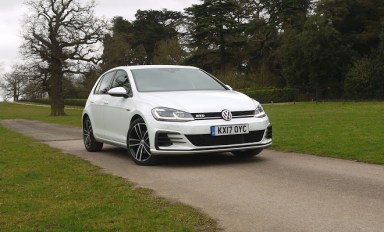
However, the Mk7.5 – as the 2017 Golf update will likely become known in enthusiast circles – also carries over all the old favourites as well. Including the Golf GTD high-performance diesel model.
The GTD is the pragmatic performance choice in the Golf range. Instead of the 2.0-litre turbo petrol used by the GTI (which now sports 230hp as standard), the GTD uses a 2.0-litre turbodiesel.
As a result it produces 184hp and takes 1.1 seconds longer to go 0-62mph than the GTI, but also returns much better mpg – both on paper and (especially) in the real world. Add company car friendly CO2 ratings, and a visual appearance that’s almost but not quite as arresting as the GTI proper, and you can easily see what makes it attractive.
In fact, the GTD hatchback is the best-selling individual trim and engine combination in the new Golf line-up – although that does only add up to 7% of total sales.
Combine this degree of efficient speed with the more practical bodywork and you’ve got a car that ticks a lot of boxes. And that’s before we get onto some of the new Golf’s technology highlights.
The GTD is designed to deliver fast but relatively relaxed progress – so while it comes with sports suspension as standard it is not intended to be as focused as the petrol powered GTI.
This means it also isn’t quite as engaging to drive. But as a car to live with day-to-day the combination of 7.9sec 0-62mph performance and claimed 60.1mpg fuel economy (both figures for the GTD when equipped with the standard manual gearbox) is likely to more than make up for any perceived shortcomings in cornering prowess.
For reference, the GTI – which only comes as a hatchback – has claimed fuel economy of 44.1mpg.
This breadth of talent from the GTD can be enhanced by the optional Dynamic Chassis Control, which adds a choice of Comfort, Normal and Sport suspension settings. With quite a pronounced difference between the character of Comfort and Sport – exacerbated by changes to engine response and noise in addition to the increasing firmness of the suspension – you can tailor the car to your mood or circumstances.
The laid-back nature of Comfort also suits the optional DSG automatic gearbox, which in one of the few heavy duty engineering changes to the updated Golf now features seven ratios instead of six, helping it to use less fuel. However, if you are a more enthusiastic driver, the six-speed manual gearbox provides greater involvement.
Standard equipment on the Golf GTD is reasonably generous, with highlights including:
- Ambient lighting
- Autonomous emergency braking with (new) pedestrian detection
- Climate control
- Full LED headlights with dynamic range adjustment
- 17-inch alloy wheels and sports suspension
- Bespoke ‘sporty design’ bumpers
- Sports seats with ‘Clark’ grey tartan cloth centres
But if you want real excitement you’ll need to turn to the options list.
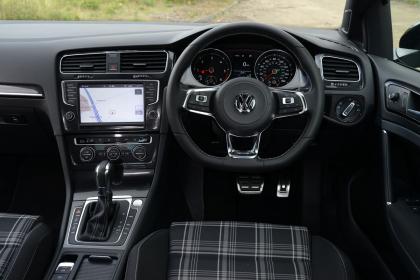
Take the new Discover Pro infotainment system, for example. This new 9.2-inch touchscreen not only gives the centre console a really modern look, it also features a fairly rudimentary gesture control – a first for the family car segment.
There’s more modernity in the form of an all-digital instrument cluster, wireless smartphone charging and even in-car internet connectivity. VW was already offering Apple CarPlay, Android Auto and Mirrorlink, but the list of associate apps is getting ever bigger.
New safety options include Traffic Jam Assist, which uses the adaptive cruise control and lane keeping assist systems to navigate congestion autonomously up to 37mph; don’t get your hopes up too high, however, as it’s not as sophisticated as some similar technologies, and won’t work if it can’t ‘lock on’ to the lane markings correctly.
Emergency Assist, meanwhile, aims to automatically bring the Golf to a halt if the driver becomes incapacitated. I’m pleased to report that I had no occasion to test that.
Sporty diesel cars are a relatively rare commodity, with the GTD’s closest rival being the Ford Focus ST Diesel.
The Focus is significantly cheaper to buy, with prices starting at £24,045 at the time of writing, versus £28,770 for the Golf. It’s also arguably a more entertaining drive, though considerably more thuggish with it.
Perhaps more pertinently, the VW is faster and much higher quality inside. The 2017 VW Golf GTD is, quite simply, an excellent all-rounder. True, a full-blooded Golf GTI will be more fun, while a Focus ST Diesel will probably prove cheaper. By buying the GTD over its petrol brother you will lose around 10% of the thrills but gain more than 10% back in economy. A Seat Leon FR 2.0 TDI may have the same engine as this and come in cheaper, but the Golf is a nicer place to be and has better badge appeal which ultimately means a better residual when it’s time to sell.
 Elliott On Air