
The old well-worn expression that says ‘if it ain’t broke – don’t fix it’ explains Nissan’s light revamp approach to a formula that has without question been one of the company’s great success stories -the Nissan Qashqai.
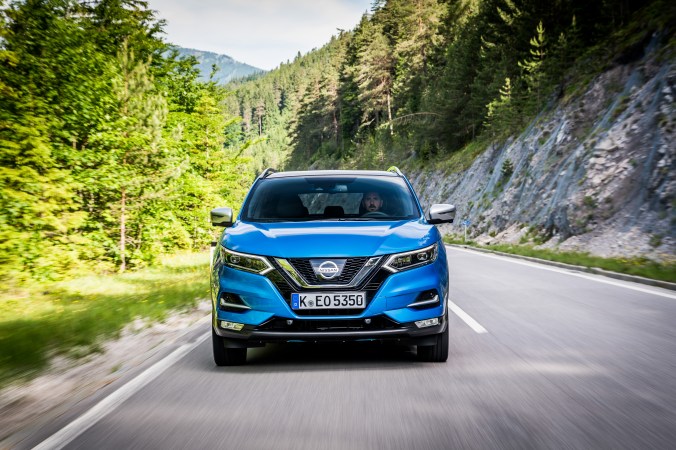
What was arguably a controversial decision a decade ago to edge away from the family hatchback into crossover territory has paid dividends time and time again with 2.3 million Qashqai’s finding new owners across Europe and it is the third best-selling car in the UK. So when you start by effectively creating and almost entirely owning a market segment for a decade, the light touch approach to updating things makes a lot of sense.
It may be tough at the top, but staying there is tougher still and mainstream manufacturers have all cottoned-on to the profitability of the mid-sized crossover and explains why a raft of fresh rivals have emerged like the SEAT Ateca, Peugeot 3008, Hyundai Tucson, Kia Sportage, VW Tiguan and Alliance partner the Renault Kadjar. It’s now a crowded marketplace, almost crossover war, so Nissan’s approach to the once redesigned, twice updated Qashqai 2017 revisit is concentrated on boosting quality, refinement and technology aimed at breathing some new life into its biggest money-spinner and leaving the basics that have made it so successful and appealing to buyers well alone.
The 2017 changes are largely what you’d expect of a mid-life update – revamped exterior styling including a new bonnet and bumper and the more distinctive new signature ‘V-Motion’ front-end design adapted from the latest Micra, a new rear bumper with satin silver finisher at the rear as well as reshaped daytime running lights (front and rear), fresh colours and aero-optimised 19-inch alloys. Underbody airflow is further enhanced in the form of neat underbody ‘vortex generators’ which aid stability, reduce drag and cut wind noise and Nissan claims Cd of 0.32 as “best in class”.
Inside, the focus has been on improving perceived quality rather than dazzling with new tech. More tactile materials and extra leather on the doors, dash and centre console make the environment feel special and fairly upmarket. The new steering wheel design is both smarter to look at and nicer to hold. It’s been completely redesigned with a flat bottom, a wider D shape opening to improve instrument view with bolstered thumb grips. Interior materials and finish are noticeably improved. There are new satin and chrome finishers, one-touch power windows on all doors, reshaped seat foam, a new eight-speaker Bose stereo system and improvements to the Nissan Connect infotainment with a more app-like interface and digital radio on all variants. Though these are welcome improvements the unexciting cabin design lacks the consummate wow factor of the Peugeot or the ergonomic superiority of the SEAT.
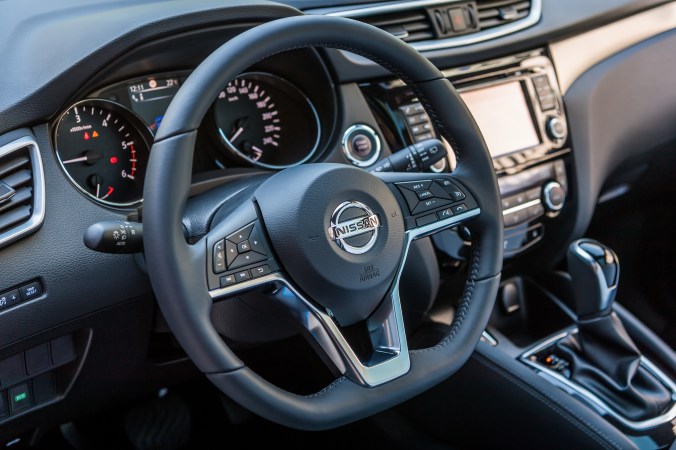
Buyers are increasingly opting for higher spec cars so a new Tekna + trim level has been introduced. The new Tekna+ flagship trim is loaded up with premium kit such as 3D-effect quilted leather and an eight-speaker Bose sound system. Electric heated seats, a panoramic glass roof, adaptive LED lights and Nissan’s 360-degree parking camera are also included, while safety kit improves with the addition of rear-cross traffic alert and pedestrian detection for the autonomous braking system. The refresh also means better door seals and insulation which are welcome making the Qashqai admirably quiet at speed for a small SUV, with only minor wind rustle making its presence known in the cabin. And the improvements keep on coming – thicker rear side glass, retuned dampers and springs, improved active ride control to reduce body roll over bumps, a stiffer antiroll bar, thicker steering shaft and the electric power steering (EPS) now incorporates active return control advancing return-to-centre steering )which claims to make the steering’s self-centring feel more natural) and a new dynamic damper. There’s also a variation of hill holder called stand still assist on manual transmission models which applies the brakes for three minutes after you lift off the pedal or until you pull away. Activated by a small hold button adjacent to the electric park brake switch, this works very well indeed, once you learn to trust it and the limitations.
Body control is reasonable and the Qashqai never feels unruly or distracted, but it does lack the sharpness of the SEAT Ateca and the agile feel of the 3008. The manual gearbox has quite a long throw and loses any sporty or engaging feel as a result. The ride is however more settled than the old car, with less fidgeting over challenging surfaces.
Qashqai engine choice has been revamped over the years and the 115PS 1.2 turbo and 163PS petrol units remain along with the 110PS 1.5dCi diesel. The 130PS 1.6 has recalibrated software and more sound insulation to improve refinement. Sampled with both manual and Xtronic CVT, it’s a very smooth and quiet engine, almost indistinguishable in sound from the 1.6 petrol, but with a bit more low end torque. It’s pretty hushed when running at temperature, although as with most diesels, if you work it beyond 4,000rpm it can get quite gruff.
It’s fair to say the revised Qashqai delivers respectable economy figures, though the cheaper and more economical 1.5 should prove popular and offer enough performance for the majority of drivers. This does costs over £30,000, however, putting it well within the territory of larger SUVs such as the Kia Sorento and Skoda Kodiaq. The mid-spec N-Connecta option offers the best compromise between equipment and price point.
So what’s the verdict? Well due to the reasons mentioned above – namely more competition in the sector – the Qashqai is not the undisputed class leader it once was but is still one of the best small SUVs around make no mistake. Nissan’s efforts to update the Qashqai are commendably more embracing than some other manufacturers, nothing has been dramatically transformed which is exactly the idea. The minor tweaks in design, cabin quality and new safety tech is welcome, though it doesn’t feel as different to drive as the publicity would lead you to believe – which again is kind of the point. Regardless, this remains one practical, efficient and decent drive family crossover. The Ateca and CX-5 are more fun to drive, just as comfortable and feel more modern inside. In a crossover war the fight for sales may ultimately come down to value for money. Let battle commence.
 Elliott On Air