
Volvo has been at the cutting edge of automotive safety for years, and the V40 is no exception. Although it competes directly with the Ford Focus, Vauxhall Astra and Volkswagen Golf, Volvo’s increasingly upmarket image means it can attract customers from the BMW 1 Series, Audi A3 and Mercedes A-Class, as well as the Lexus CT 200h.
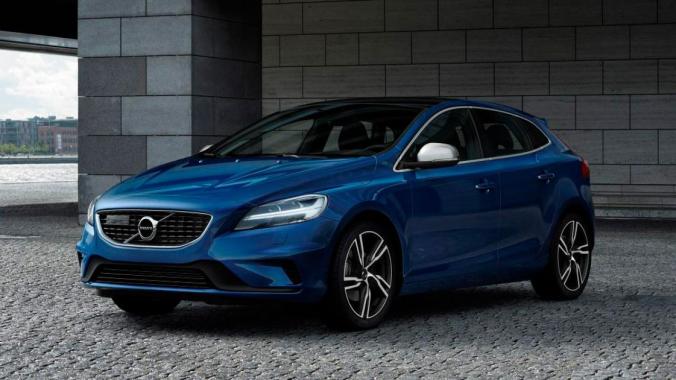
Pitted against such desirable premium-brand company, Volvo’s distinctive, classy curves certainly helps set it aside from more mainstream models. Since its 2016 facelift, when ‘Thor’s Hammer’ daytime running lights were introduced as a stylistic family link with the Volvo XC90 SUV and classy Volvo V90 estate, Volvo cars have become more and more distinguished. Changes to the rear end are more subtle and the V40 is still characterised by its dark tinted rear hatchback and wraparound light clusters, while all models have sporty-looking twin exhausts.
The V40’s credibility against premium rivals is maintained inside, where the materials are first-rate and everything feels very solid as you’d expect. The sheer number of buttons on the dashboard is rather behind the pace compared to the large touchscreen displays found in competing models which can feel a bit retro and fiddly to navigate some of the menus on the move until you get used to where everything is. The front is really where the best seats in the house are being both attractive and very comfortable on even the longest of journeys including my 500 mile round trip. Things aren’t quite as impressive in the back though. There’s reasonable space for two adults, but the centre rear seat is rather cramped and best suited to a child.
Volvos don’t have a great reputation for providing engaging driving experiences, but the V40 looks to change that. Traditionally the Volvo name is associated more with safety and practicality than driver appeal but the V40 is a genuinely entertaining car to drive thanks in no small part to underpinnings being shared with the Ford Focus. A big criticism of Volvo’s of old was the amount of lean that sometimes made you think you were on a ship suffering from sea sickness but the new generation is a world away. The V40 barely leans at all in corners, the tyres offer loads of grip and there’s a rugged Volvo V40 Cross Country version with four-wheel drive and more ground clearance for those who regularly encounter more challenging road conditions.
The engine range is maybe more complicated than it need be with sizes dictated by whether a manual or automatic gearbox is chosen. Petrol models are the 120bhp T2 and 150bhp T3, automatic versions of which have a 1.5-litre and manual examples a 2.0-litre engine, while the automatic-only T5 has a 2.0-litre 242bhp engine good for a 0-62mph time of just 6.4 seconds. All diesel models use a 2.0-litre engine, in 118bhp D2, 148bhp D3 or 177bhp D4 varieties.
The petrol engines are impressively economical with even the powerful automatic T5 returning 47.9mpg. The best fuel consumption is offered by the 78.5mpg D2 diesel but I’d recommend the rather nippier 74.3mpg D3, which can take the V40 from 0-62mph in 8.4 seconds. The D4 is remarkably quick, doing 0-62mph in 7.4 seconds, despite using no more fuel than the D3, but it costs rather more to buy so you really pay your money and take your choice but choice aplenty there is.
There are several trim levels available, allowing you to choose not only how luxurious your V40 is, but also how sporty – yes sporty – you want it to look. Entry-level Momentum is far from basic, with air-conditioning, DAB radio, Bluetooth, alloy wheels, LED headlights and a five-inch colour display, but you need to opt for the Nav Plus to get sat nav, rear parking sensors and cruise control. Inscription models are very comfortable and elegant, with leather seats, a digital dashboard in place of conventional instruments, 17-inch alloy wheels, an upgraded stereo and stylish interior trim.
The sporty-looking R-Design mirrors the Momentum, but adds sports seats, a body kit and sports suspension, while the R-Design Pro adds leather upholstery, 18-inch wheels, sat nav, rear parking sensors and a stereo upgrade. It’s also possible to fit performance parts from Polestar, a tuning specialist that is now fully owned by Volvo that is to the Swedish carmaker what AMG and M Division are to Mercedes and BMW. Dealer-fitted upgrades include engine software to increase power, performance exhausts and alloy wheels, available individually or as upgrade packages.
Although it was crash-tested by Euro NCAP some time ago – back in 2012 – it easily achieved the full five stars as you’d expect and was the safest car in its class, just missing a perfect performance with 98%. Impressive stuff.
Coming 78th out of 150 models in a recent customer satisfaction survey, the V40’s does have some shortcomings if not many, but coming 43rd for reliability is a decent finish, so this shouldn’t be too alarming.
The amount of choice in the family hatchback class can be overwhelming, but if you want an upmarket, stylish, understated, curvy and comfortable car, the V40 has to be a very convincing choice. The V40 will also appeal to anyone who also wants a car that’s just a bit different. Whatever your impressions of a Volvo, this car will surprise, amaze and delight all in one, with everyday practicality thrown in for good measure.
The V40 is a very capable all-rounder in this fiercely competitive area of the industry. It’s Volvo’s best-selling model in Europe and the 2017 updates are set to continue that success because the V40 is already nice to drive as well as comfortable and the stylish updates make it stand out from the crowd and easy on the eye. The premium atmosphere of the interior and standard equipment included only add to the appeal. It may not have a badge as prestigious as the A-Class or 1 Series – yet – but Volvo are certainly closing that gap with this car.
 Elliott On Air