
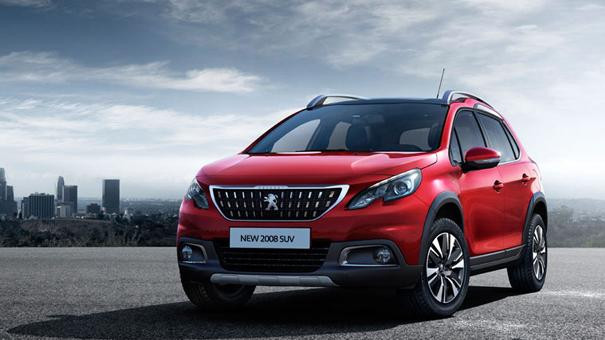
The 2008 is Peugeot’s compact SUV that competes with strong sector competition in the form of the Citroen C4 Cactus, Renault Captur, Kia Soul and Nissan Juke. All of these front-wheel drive cars offer an SUV-like stance, urban-appropriate supermini dimensions, and low running and purchase costs.
The 2008 is a family-friendly SUV, a tall, 208 supermini-based, four-metre-long entrant into an increasingly crowded market. The platform beneath the 2008 is the same as the one that underpins the 208; there’s no four-wheel drive option to drastically alter the similarities. Overall the 2008 might be a heavier car, but it is far more practical than the supermini on which its based.
There are many different engines and trim options to choose from. The 1.2-litre petrol is available in three outputs, badged 82, 110 and 130. The 110 feels punchy and flexible, and willing to rev. However, if you do a lot of motorway miles it may be worth considering that the 110 gets a five-speed manual, where the 130 gets a six-speed manual that sees it hold lower revs at motorway speeds so less engine wear and less engine noise. A 1.6 BlueHDi diesel is also available in three power outputs – 75, 100 and 120 offering good flexibility. The higher powered versions of the 1.6 diesel and 1.2 petrol, when bought in mid-spec Allure trim or up, get Peugeot’s Grip Control – effectively a more advanced traction control system.
It has to be said the 2008’s ride is a weak point. At lower speeds, uneven road surfaces and potholes send thumps through the cabin, and as speed builds the imperfections feel less harsh but still cause the 2008’s body to become unsettled especially for those in the rear. Sticking with the smallest wheels possible will keep sharp-edged bumps at bay to a degree, but you’ll still feel them more than in rivals.
The 2008 feels at home in urban traffic. Its light steering makes it easy to zip in and out of lanes, while low-speed manoeuvres such as parking are made that bit easier. However, with more speed comes less composure, as tight turns do cause the 2008’s body to lean more than you feel it shoud.
The light steering might may have its benefits, but it doesn’t help matters at speed. It gives very little feel of the position of the front wheels and can feel overly reactive initially and it just doesn’t inspire much confidence.
The 1.2 petrol is actually the most refined of the range. It never becomes too noisy, and apart from some slight buzz through the pedals at its top end, it’s generally smooth.
The diesels are more vocal than you’d like them to be, and start to send noise and vibration into the cabin beyond 3000rpm, but their good torque means you shouldn’t have to work them hard to make progress.
On the motorway you’ll notice a fair amount of wind noise around the door mirrors, and quite a bit of road noise echoing around the cabin as well. Suspension noise is a noticeable at lower speeds. The manual gearbox isn’t the slickest, either and the car seems to struggle to adjust to what gear its happiest in, and the five-speed automatic can be jerky.
As with the 208, the 2008 has an unusually small steering wheel that you look over (instead of through) to see the instruments. Unfortunately, if you’re less than six feet tall, you may well find the top of the wheel blocks your view of the speedo which can make for a distracting driving experience.
Getting comfortable isn’t too much of a problem though. There’s a range of manual adjustment on both the steering wheel and driver’s seat, and driver seat height adjustment is standard across the range. Reaching the dashboard controls doesn’t require stretching too far, either, but there isn’t even the option of lumbar support which is a shame.
Longer journeys shouldn’t be tiresome in models with the manual gearbox, because drivers will find the pedals line up nicely with their seat, so a good driving position is a positive as you aren’t forced to sit at an awkward angle for hours on end. All models have nice, deep windscreens and thin front pillars with little to obstruction to a decent line of sight. The front side windows are deep, too, helping visibility at junctions and roundabouts. Over-the-shoulder visibility isn’t quite as good. The 2008’s rear screen is small, while its rear pillars are thick, so it has bigger blind spots than when looking forward strangely.
Front parking sensors aren’t available on any 2008, even as an option. Rear sensors come as standard from Allure trim upwards and are optional on Active cars, but aren’t available on entry-level Access A/C trim at all. GT Line gets a reversing camera as well as audible parking sensors which seems sensible on a tall car such as this.
The touchscreen infotainment system – standard on all but the entry-level trim is disappointing, because it’s fiddly to use on the move and there are no shortcut buttons to help you negotiate its menus which can be distracting and frustrating. The screen has reasonably modern graphics, but it’s unresponsive often leaving you stabbing at buttons a few times only to hit something you didn’t want. Dragging menu bars up and down requires patience and some practice too.
Entry-level cars get two speakers, FM radio, USB input, Bluetooth, steering-column mounted audio controls. The rest get the 7.0in colour touchscreen, DAB radio, and Apple CarPlay and Mirrorlink on top of that. Sat-nav is an option on all models apart from top-spec GT Line, which is a shame since you get it as standard even on lower and more affordable trims in the Renault Captur.
Peugeot has done a good job making everything you see and touch in its cabin look and feel high quality in the price range. In this regard it is better than rivals such as the Nissan Juke, Renault Captur and Citroen C4 Cactus. The dashboard and door cards are covered in pleasant, soft-touch plastics, while the chrome accents are a nice touch even if they aren’t actually metal. The further down the dash and doors you go, the cheaper the plastics feel, but everything of a good standard and everything feels well screwed together which should inspire confidence
The 2008 has enough room to seat two tall adults with aplomb. Head and leg room are all fairly generous. However, head room in the 2008 is limited when the car is fitted with a panoramic roof, and shoulder room is poor by the class standards. All of the 2008’s rivals are good in these departments, with at least a comparable amount of room on offer.
There are two cupholders that sit ahead of the gearlever, and each door has a pocket big enough to accept a 1 litre water bottle, although it never feels secure. The 2008’s glovebox is also small, so you won’t fit much more than the driver’s manual inside which makes it almost redundant. Instead of an armrest between the front seats, Peugeot has fitted a large cubbyhole covered by a sliding cover, which is ideal for storing things like a phone, keys or wallet.
The 2008 is spacious in the rear compared to other small SUVs such as the Nissan Juke. Two lofty adults enjoy good head room, and leg room is also good if those in the front aren’t too tall. However, seating three adults across the rear seats might be a bit of an ask; three children will be fine, but a middle adult will struggle to position their feet comfortably and will have to straddle a quite prominent transmission tunnel.
Rear doors have their own pockets but these are noticeably shallower than the ones at the front. Each front seat comes with a pocket on the rear of its backrest for storing magazines or maps. Although driver’s seat height adjustment is standard across the range, passenger seat height adjustment doesn’t feature until Allure trim. Even so, there’s still enough base and backrest adjustment for front passengers of most shapes and sizes to find a comfortable seating position.
Rear seatbacks can be adjusted for comfort as well as folded 60/40, and as they’re spring loaded, can be folded with just a touch of a button rather than having to actively fold them down manually.
The 2008 has a 360-litre boot, which is bigger than a Juke’s, but smaller than a Renault Captur’s. It’s a nice useable square shape and the boot floor sits flush with its lip, so loading heavier items is easy, and the boot opening is tall and wide with no obstruction. The rear seats lie completely flat one folded which makes it easier to slide long items in. This means an entirely flat surface from the boot entrance right through to the front seats – again, no obstructions means easier loading.
If you keep the 2008 sensible in terms of its engine and trim, it’s competitively priced against rivals such as the Nissan Juke, Renault Captur and Citroen C4 Cactus. Opt for higher trims and silly options and you will see little extra for the additional outlay.
If you’re buying privately go for the 1.2 petrol, especially if you do a lot of town driving. It’s well priced and cheap to run and CO2 emissions dip below 100g/km when paired Peugeot’s EGC automatic gearbox, although it’s not brilliant to drive. Company car drivers should look at the 1.6 BlueHDi, which emits the least CO2 of the range. It’s more expensive, though, so it’s best for those who cover above-average mile and can claw back the extra cost with better fuel economy.
Like all of its rivals, there are some extremely attractive finance offers on the 2008, and running costs such as insurance, road tax maintenance are very reasonable. Avoid entry-level Access A/C trim as it’s the only model in the range to not get an alarm, DAB radio, alloy wheels or a leather-trimmed steering wheel, although it does get air-con, USB input and cruise control. Active trim comes with 16in alloy wheels, a colour touchscreen, USB socket, Bluetooth and a DAB radio. It’s the one to buy whether you’re buying privately or through work, because it has everything you realistically need for a sensible outlay. However, you can only get this trim with the lowest powered versions of the petrol and diesel engines.
Allure trim is worth looking at if you want more features. It includes rear parking sensors, 17in alloys, LED interior lighting, dual-zone climate control, fog lights and (if you go for the higher powered engines) Grip Control. Top spec GT Line gets some stand-out styling features and is the only trim to get sat-nav as standard.
The 2008 hasn’t featured in the latest round of reliability surveys, but Peugeot itself managed to finish twelfth out of 25 manufacturers, which is decent. However, the 208, which the 2008 is based on, didn’t score quite so well. It managed 19th place out of the 24 small cars included in the survey, with windscreen wipers, door mirrors and booth hatch problems among the most frequent. Every 2008 comes with Peugeot’s standard three-year, 60,000-mile warranty, and this can be extended. Servicing can be paid for via monthly plans rather than all in one go to help spread cost.
The 2008 has as much safety equipment as you’d expect, without going the extra mile. Stability control is provided across the board, as are front, side and curtain airbags and the 2008 got the maximum five stars in Euro NCAP crash tests.
Deadlocks and an immobiliser are standard, but base Active A/C trim doesn’t get an alarm. Even so, security firm Thatcham awarded the 2008 full marks for its resistance to being driven away, and good marks for its resistance to being broken into.
The Grip Control system that you get on more powerful models is a neat addition that few rivals offer, too, since it does make things easier in tricky surface conditions, without affecting the good on-road efficiency of this front-wheel drive SUV.
The Peugeot 2008 is a better car than you might expect it to be on several counts: on performance, on efficiency and not least how it handles. But somehow it’s a bit too predictable, a bit unadventurous and it’s hard to know what its key selling point actually is.
 Elliott On Air