
While the Vauxhall Astra family hatchback has always sold in big numbers, it has often been just behind the class leaders, whether they had slightly better engines, tighter handling or were simply more desirable. Perhaps that’s why Vauxhall has really gone to town in designing the seventh-generation Astra, making it a far better car as a result.
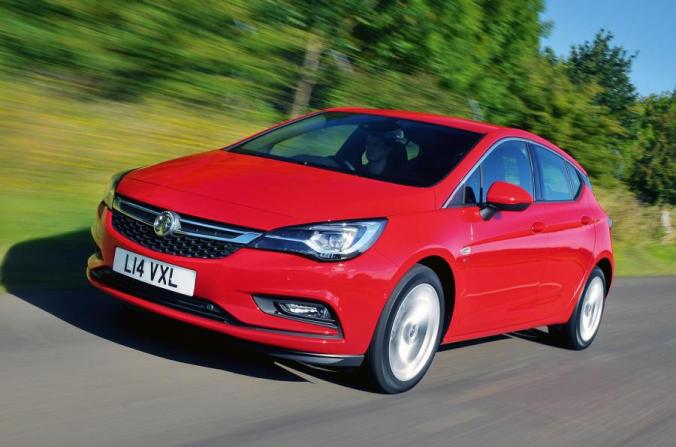
It might not look radically different, but the Astra is leaner and more purposeful than before, with a range of clever engines, almost uncanny refinement and suspension that soaks up most imperfections, but manages to sit between the Focus and Golf for driver involvement. Forget the old Astra’s dowdy image, because it’s now a real alternative to the Ford and VW, along with rivals like the Renault Megane, SEAT Leon, Kia Cee’d and Hyundai i30.
A large factor in its rejuvenation has been an impressive diet, with this Astra weighing around 200kg less than the old one – the equivalent of driving around with three fewer people in the car. It’s a little shorter overall, but pushing the front and rear wheels further apart means the interior is actually more spacious. This design change helps the Astra look more athletic – as do its modern headlights and rear window pillars, which slope up to meet the roof in a similar way to a coupe.
There are plenty of engines to choose from, with five petrols and three diesels, starting off with a 1.4-litre carried from the old model that feels dated. Its fuel economy of 52.3mpg isn’t too bad, but CO2 emissions of 124g/km are high for a car taking a lethargic 12.6 seconds to get from 0-62mph.
While it only has three cylinders, the 1.0-litre petrol with 104bhp is far more advanced, takes a sprightly 10.5 seconds to complete the same sprint and returns 64.2mpg, while emitting only 102g/km of CO2, for a £20 road-tax bill (if registered before 1 April 2017).
If you crave more performance, there’s also a 1.4-litre petrol with 123 or 148bhp, returning just over 50mpg and emitting between 124 and 128g/km of CO2. A 1.6-litre petrol turbo with 197bhp is the quickest Astra in the standard line-up, hitting 62mph from rest in 6.6 seconds, but costing more to run (46.3mpg and 141g/km).
Choose a diesel and the same 1.6-litre engine is available with 109, 134 and 158bhp, with the top version getting two turbochargers, hence its ‘BiTurbo’ badge. All three feel powerful on the move, with the entry-level engine accelerating from 0-62mph in 10.3 seconds and the power upgrades chopping off a second each (nine and 8.1 seconds respectively). The ecoFLEX model with 109bhp can return up to 85.6mpg, while the faster versions return up to 74.3 and 68.9mpg. The BiTurbo costs £20 annually to tax, while the others are free to tax – in both cases as long as they’re registered before the tax system changes in April 2017.
The quality of some interior materials might not topple the VW Golf, but the Astra’s dashboard feels much more contemporary and logical, while the standard ‘IntelliLink’ infotainment system gives in-car technology a real boost. It has cleaned up the glut of buttons Vauxhall tended to favour too, although we’re appreciative that the climate control still has physical controls.
Back-seat passengers will find 35mm more kneeroom and while the boot isn’t class-leading, it is generous: its 370-litre total is just 10 litres off the Golf.
Vauxhall has honed the Astra’s suspension on UK roads and you can tell. There’s a great compromise between ride comfort and driving pleasure. Poor roads and potholes won’t jar occupants too badly, but the suspension doesn’t sag or lean in sharp corners. The Focus just has the edge for pure driving fun, but the Astra is very happy whether it’s on a twisty country lane or the M6.
Vauxhall offers a confusing array of nine trim levels, but at least that means you should be able to find the exact car to suit you – with some guidance. They start with Design and progress via Tech Line, Energy, SRi, SRi Nav, SRi VX-Line, SRi VX-Line Nav, Elite and Elite Nav, with every Astra getting essentials like air-conditioning, a touchscreen, Bluetooth, cruise control and DAB radio as standard.
Most importantly, SRi models tend to have a sportier theme, while Elite trims are designed with luxury and convenience in mind, offering executive must-haves like leather upholstery, heated seats and even a heated steering wheel. Our pick is the Tech Line, which gets desirable features such as an eight-inch infotainment screen and sat nav, without costing too much extra. Versions from SRi and above get Vauxhall’s OnStar as standard, which not only acts as a concierge service, but can also report your exact location if you’re involved in a crash or need roadside assistance.
At the 2016 Car Tech Awards, the Astra came top in the best self-parking system and best safety innovation categories for cars under £25,000, with the latter thanks to OnStar. The Astra also received a commendation for its sat nav.
The Astra should certainly protect occupants in an accident, with a five-star crash safety rating from Euro NCAP. In our 2016 Driver Power customer satisfaction survey, the Astra came 67th out of 150 models for reliability, while the Vauxhall brand improved from 30th to 25th out of 32 manufacturers, so it still has plenty to do.
 Elliott On Air