
A good engine range, impressive refinement, a well-made interior and a generous level of standard equipment combine to make the Hyundai i30 an excellent family car. But all the gadgets and improvements mean the latest model is similar in price to the Volkswagen Golf, and the Golf is still the better all-rounder.
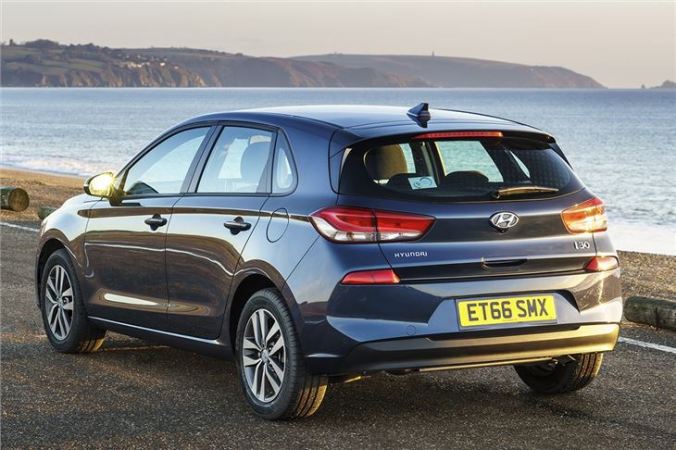
That said, on the road, the i30 is better to drive than ever before, with plenty of grip through corners and decent steering. The suspension is comfortable on all but the most uneven and broken of roads, yet it does a very good job of keeping excess body roll at bay when cornering.
All of the engines are quiet and capable, but the 1.6-litre diesel is only worth choosing if you do a lot of miles. The 140PS 1.4-litre petrol is just as punchy but it’s quieter, while the 1.0-litre is far from a poor relation, thanks to a wide torque spread that makes for surprisingly strong acceleration when on the go.
Inside, the i30 is very well thought-out. It maybe lacks the style or panache of other hatchbacks this size, but it feels well built, durable and most importantly – is simple to use. The seats are comfortable, the driving position is good and there is plenty of space, although taller occupants might struggle for rear headroom. The boot is sizeable though, at 395 litres and it’s a good shape, so getting awkward items in and out is easy.
Even entry-level i30s come with some very useful equipment, including cruise control and a speed limiter. Lane keep assistance is standard too, which attempts to stop the car drifting out of its lane on the motorway, plus there is autonomous emergency braking to prevent or reduce the severity of collisions.
The Vauxhall Astra, Skoda Octavia and Volkswagen Golf are all excellent family cars and while the Hyundai i30 is better than ever, it still only as good as those key rivals – not better. But for a pragmatic car buyer it’s great, especially when you remember that it comes with a five-year, unlimited mileage warranty.
There are in total twelve exterior colours consisting of three pearl choices: Stargazing Blue, Micron Gray, Phantom Black; and seven metallic choices: Demitasse Brown, Intense Copper, Moon Rock, Fiery Red, Platinum Sliver, Ara Blue and White Sandplus two solid choices: Engine Red and Polar White.
The Hyundai i30 is available with 17-inch two tone 10-spoke alloy wheels, 16-inch two-tone 10-spoke alloy wheels or 15-inch alloy ro steel wheels.
The floating screen of the optional eight-inch navigation touch screen on the dashboard integrates all navigation, media and connectivity features and allows drivers to stay always tuned to the traffic ahead thanks to its ergonomic position.
The new multifunction three-spoke steering wheel allows easy and intuitive operation of all functions through an ergonomically positioned operation controls and can be heated for enhanced comfort. The climate and temperature control is positioned conveniently in the centre console and can be easily operated through the dials without distracting the driver.
To enable customers to carry everything they need, the i30 offers luggage capacity of up to 395 litres (VDA 211) and a maximum of 1301 litres with the seats folded flat. Practicality is enhanced with a practical two-stage luggage board and a ski hatch in the rear centre seat.
For the interior, customers can choose from three colour options: Oceanids black with two different cloth seat options or black leather seats, a two-tone combination of Slate Grey and Oceanids black with cloth or leather seats featuring diamond pattern or the two-tone combination of elegant Indigo Blue and Oceanids Black with leather seats.
There are three petrol engines and one diesel engine. All engines come standard with Integrated Stop and Go (ISG) system for increased efficiency.
Customers can choose between the new 1.4 T-GDI turbocharged four-cylinder engine – a Hyundai first – with 140PS, the 1.0 T-GDI turbocharged three-cylinder engine with 120PS or the 1.4 MPI four cylinder with 100PS.
There is one diesel engine: the 1.6-litre turbocharged four-cylinder diesel engine, available with three power outputs: 95, 110 and 136PS and CO2 emissions starting from as low as 89g CO2/km (target value). Mated to the engines is either the six-speed manual transmission (6MT) or Hyundai’s efficient and direct-responding seven-speed dual-clutch transmission (7DCT).
Prices will start from £16,995 for the i30 S 1.0 T-GDi 120PS 6 speed manual, which offers 15-inch alloy wheels, LED daytime running lights, DAB radio with USB and aux connections, Bluetooth with steering wheel controls, electric front and rear windows and driver seat height adjustment.
From £18,695, the i30 SE 1.0 T-GDi 120PS Manual builds on S trim level by offering customers additional equipment including 16” alloy wheels, front fog lamps, DAB radio with 5” LCD touchscreen, rear parking assist system, rear view camera and leather steering wheel. SE specification is also available with a 1.6 CRDi 110PS, with 6-speed manual transmission.
Moving further up the range, the i30 SE Nav 1.0 T-GDi 120PS Manual at £19,645 continues with SE specification and adds additional enhancements to technology and connectivity, with integrated satellite navigation with 8” LCD touchscreen, Bluetooth with voice recognition and wireless phone charging*. As a £1000 customer option, SE Nav specification is available with the Visibility Pack, which comprises dual LED headlights, 17” alloy wheels and dual zone climate control.
SE Nav specification is also the first trim level to introduce the new 1.4 T-GDi 140PS engine, available with a 6 speed manual, or 7 speed DCT transmission, whilst the 1.6 CRDi 110PS engine, available with either a 6 speed manual or 7 speed DCT transmission, is an additional customer option.
Raising the specification further, Premium starts at £22,195 for the 1.4 T-GDi 140PS Manual. Premium trim includes 17” alloy wheels with uprated Michelin tyres, dual zone climate control, electronic parking brake with auto hold function, privacy glass and heated front seats with artificial leather/cloth seat facings. Drivers also benefit from an electrically adjustable seat, a supervision instrument cluster with 4.2” display and driver assistance systems including front and rear parking assist system and blind spot detection system with rear cross traffic alert and LED front headlights and rear combination lights. At Premium trim level, the 1.4 T-GDi with a 7-speed DCT transmission and a 1.6 CRDi 110PS engine with either a 6-speed manual or 7-speed DCT transmission are also available.
The top of the range Premium SE enters the range at £23,495 for the 1.4 T-GDi 140PS Manual, adding panoramic sunroof, leather seat facings and a heated steering wheel to the Premium specification. Premium SE is also available with the 6 speed manual, 7 speed DCT transmission, with either the 1.4 T-GDi 140PS or 1.6 CRDi 110PS.
Inside, the Hyundai i30 feels very well made, with sturdy plastics and a very neat and intuitive layout. Okay, so it’s not particularly ‘premium’ in look but it’s designed to be easy to use – and it does that very well.
Most models come with a large touchscreen system on top of the centre stack, which is responsive and easy to get to grips with. Ventilation controls are separate, so there’s no faffing in touchscreen menus to warm up or cool off.
Go for SE Nav trim or higher and you’ll get Android Auto and Apple CarPlay, which enables use of smartphone functions like Google Maps navigation and Spotify music streaming via the built-in touchscreen, as well as calls. If you only need simple connectivity then Bluetooth is standard across all models.
The driving position is very good, with plenty of adjustment so drivers of all shapes and sizes can get comfortable, plus there is a decent amount of rear space. Tall passengers might struggle for head room in the back row, but for children or there should be no problems at all.
The boot is one of the largest in a family hatchback at 395 litres. It’s well shaped, with a nice wide, flat load area and a double floor for hiding valuables. The rear seats fold almost completely flat, which increases load space to 1301 litres – plenty for picking up flat packs or taking rubbish to the tip.
The rear doors open wide, so getting children in and out of child seats is easy, although with a taller driver (or passenger) in the front, there’s precious little legroom behind. The Nissan Pulsar has far more space for those in the back.
On the plus side, there are plenty of little storage cubbies, plus you can get a handy wireless phone charger on high-spec variants.
Standard equipment includes alloy wheels, air conditioning, auto dipping headlights, auto emergency brakes, lane keep assist, DAB radio, Bluetooth and cruise control. We’d recommend going for SE or SE Nav trim though, since these come with more luxuries including a touchscreen system.
The Hyundai i30 feels like a quality car and that is reflected in the way it drives. It’s very quiet and refined, plus it has nicely-weighted controls that are light enough to be effortless without feeling flimsy. The result is a car that works in town, on the motorway and on a country road.
Engine choices are a 1.0-litre petrol with 120PS, a 1.4-litre petrol with 140PS and a 1.6-litre diesel with 110PS. We’d recommend the petrol engines over the diesel for most drivers, since they’re both punchy and responsive, plus they have official economy of more than 50mpg.
The diesel, on the other hand, is quite flat and unresponsive at low engine speeds, so the gearbox needs to be worked to get the most out of it. It’s fine for motorway driving, though – especially when paired to the seven-speed dual clutch transmission, which is also available in conjunction with the 1.4-litre petrol.
Motorways are made easier by the standard fit cruise control and speed limiter, plus there is lane keep assistance as standard, which will nudge the steering a little to try and prevent the car drifting out of its lane. Optionally, there is an adaptive cruise control system that matches the speed of the car ahead, which is handy on busier motorways.
The suspension is supple enough to be comfortable over all but the poorest road surfaces, yet it does a good job of controlling excess body roll through corners, so the handling is very neat and there is plenty of traction. It’s much more enjoyable to drive than previous iterations of the i30 and is a match for established rivals like the Vauxhall Astra on a twisting road.
Aside from cruise control and lane assist, Hyundai also fits all i30 models with auto-dipping headlights and an autonomous emergency braking system. The latter will automatically apply the brakes if it detects an imminent collision to minimise the impact or, in some cases, prevent it entirely.
Ultimately, while it may lack the character of some of the competition, the i30 is easy and relaxing to drive. As a fuss-free and easy to live with family hatch, it ticks all the boxes.
 Elliott On Air