 Honda is an extraordinary motor manufacturer in many ways, not least because it makes cars that are both incredibly radical and unbelievably bland, but because they’re neither remembered or hated for it.
So news that Honda has made the 10th generation Civic a “global car”, riding for the first time on one new platform that will be sold in every market around the world, rather than creating special versions for the North American, Asian and European markets, is interesting. Why would Europeans want to drive a family car that is also designed to sell in America? Americans like motors that will glide them along the interstate but Europeans are more interested in quaint things like “handling”.
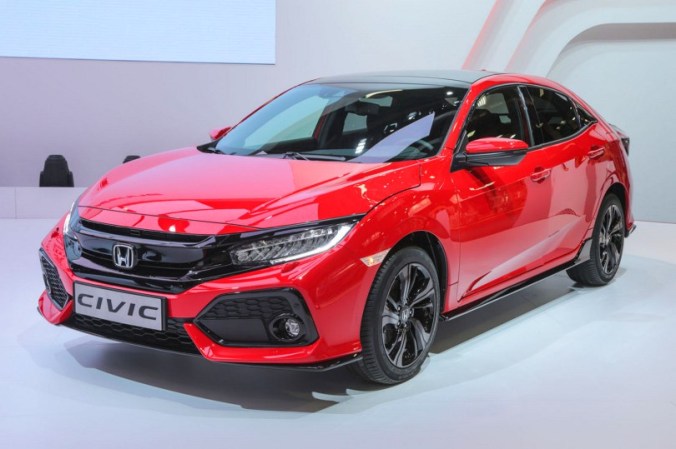
The good news is that Honda has based its global car on European tastes. While Americans will get a saloon version, the British Civic continues as a hatch only (very few of us buy small saloons) and, even better, the Swindon-built hatch will be made for export worldwide, including America. Honda expects to export 40% of its Civic hatchbacks to America.
The new hatchback finally ditches the cheap torsion bar at the back for more sophisticated, independent rear suspension. Honda’s engineers can do this partly because of economies of scale; the volume of identical parts needed for the global car is much greater and, like bulk-buying your toilet roll, there are greater savings to be had in production.
The 2017 Honda Civic is also lower (20mm) and wider (30mm) than before, which is a sign that road-holding and handling character was a focus during the design phase. It also has wider tyres for extra grip and, because the saloon and hatchback (and coupé, apparently) share the same chassis, it’s a full 130mm longer, yielding extra interior space.
Honda’s got new tricks under the bonnet, as well. A re-engineered 1.6-litre diesel is coming but won’t be available until the end of the year. When deliveries begin at the end of March, buyers have a choice of two completely new turbocharged petrol engines, a 1-litre and a 1.5-litre, which offer a thoroughly decent power output of 127bhp or 180bhp respectively, but with low annual tax costs.
You can get the 127bhp version, for example, with the CVT (automatic) transmission that produces just 106g/km of CO2: that’s the sort of CO2 level you’d expect from a clean diesel, except it’s not, it’s a petrol and so doesn’t produce the nitrogen oxides and particulates that are now understood to be the biggest health threat for anything that, well, breathes air.
Honda also says the 1-litre VTEC turbo is the equivalent of the outgoing 1.8-litre engine in terms of performance. That’s extraordinary. It has achieved this through bewildering things such as “high-tumble intake ports”, “sodium-filled exhaust valves”, “ultra-lightweight cranks” and “newly-designed water jackets”. Journalists nodded with approval at these clever developments, but Ford has of course been-there-done-that with its 1-litre Ecoboost engines.

For average buyers, there is an important point: 106g/km of CO2 puts the car in tax band B and under current rules, therefore attracts no tax in the first year and then just £20 annually thereafter. Unfortunately, the government is changing car tax rules from April 1, 2017, and if you register the same car from April, it’ll cost £140 per year.
With a choice of a six-speed manual gearbox or CVT (continuously variable transmission, a type of automatic), the more powerful engine feels lethargic with the CVT but can be coaxed into life by sticking it in Sport mode and using the steering wheel-mounted paddle shifts to “change gears” (although with CVT there aren’t actually any cogs to shift). The 1.5 pulls well across a wide rev range but couldn’t be regarded as sporty, and certainly, the performance benefits are marginal over the 1-litre motor.
The smaller engine is a little wonder that offers surprising poke from around 1,700rpm for such an efficient little three-cylinder unit. Again, the manual ‘box is more fun, with a short, stubby gear lever snicking between the six speeds delightfully, although the CVT version feels slightly less disappointing married to this engine. The noise from the 1-litre engine is more satisfying, too; a throaty grumble rather than a dull whine.
Honda makes much of the dynamic potential of the new Civic, pointing to its new lighter, stiffer chassis, as well as the lower, wider, longer stance, and revised suspension set-up and wider tyres. On the road, it proved plenty of fun, resisting roll through corners and showing an agile front end that gripped and gripped, then gripped some more, even when pushed very hard.
The lengthened chassis means there’s more space inside compared with the previous Civic, and it feels roomy upfront but gains seem marginal when sat in the back of the hatchback; those over six foot will feel a little claustrophobic. Honda has tried to make the driving position a little sportier, so the front and rear seats are closer to the floor, which definitely improves the Lewis Hamilton factor while behind the wheel but one wonders what grandma and grandpa will make of the less gainly entry and exit procedure.
The cabin design is mildly more conservative than before. A pleasing mix of soft and hard plastics on the dashboard in contrasting tones of black and grey are let down somewhat by a rather too-obviously fake carbon-fibre effect panel. Honda was aiming to give the cabin personality and inject a bit of fun but it’s not quite as stimulating as before.
On the motorway, it’s quiet and comfortable in the cabin. Honda says it has added insulating glass and more sound deadening around the bonnet, doors, rear wheel arches and under the floor. It’s effective but front passengers may notice noise as air rushes over the wing mirror. Audi spent six months working on reducing noise and improving aerodynamics around the mirrors on its latest A4, so getting this right is not as simple as one might imagine.
Honda has put huge amounts of effort into making the 2017 Honda Civic better to drive, more roomy, more fuel efficient and less polluting. Its engineers should be proud of ticking so many boxes. However, while the driving dynamics were tuned for the European market, some Brits might not warm to the body shape, while the interior may not excite in quite the same way as does the driving experience.Given its potential, though, the hot Type-R version, which will be introduced later this year, is definitely one to watch.
 Elliott On Air